Picture this. You are merging onto a busy highway. Your foot presses firmly on the accelerator. Instead of a surge of power, the vehicle hesitates. A sudden loss of acceleration, accompanied by a rhythmic metallic ticking noise, usually points to a culprit buried deep within the engine block. Many drivers immediately suspect spark plugs or fuel injectors. However, the heart of the issue frequently lies with the primary conductor of the valvetrain.
The engine camshaft operates as the mechanical brain of your vehicle's respiratory system. It dictates exactly when, how long, and how wide the intake and exhaust valves open. When these precisely machined components fail, they disrupt critical airflow. This drastically reduces overall efficiency and power output. In this engineering guide, we will break down the mechanics of valve actuation, explore its direct impact on performance, and outline top replacement standards to get your vehicle back on the road.
Key Takeaways for Valvetrain Mechanics
Lift Defined: Lift refers to the maximum distance the valve is pushed open off its seat by the cam lobe. This precise measurement directly determines the volume of air and fuel entering the combustion chamber.
Mechanical Connection: The shaft converts rotational motion from the crankshaft into linear motion. It utilizes carefully engineered lobes to push against lifters, pushrods, or rocker arms, which subsequently actuate the valves.
Performance Impact: Higher lift generally increases power at upper RPM bands by allowing maximum airflow. Conversely, a lower lift profile favors low-end torque, higher intake velocity, and improved fuel efficiency for daily driving.
Brand Specifics Matter: Modern engines utilize advanced variable timing and complex cylinder heads. Using exact factory-spec replacements is crucial for maintaining mechanical harmony and avoiding catastrophic failure.
Replacement Readiness: Recognizing the early signs of internal wear—such as ticking noises, cylinder misfires, or metallic glitter in the oil—is critical for knowing when to diagnose and purchase a replacement component.
Understanding the Valvetrain Core Component
To truly grasp how an internal combustion engine breathes, one must first examine the primary component responsible for respiratory control. A cam is a precision-engineered cylindrical rod running the length of the cylinder bank. It features a series of egg-shaped protrusions known as lobes. The fundamental job of this rotating shaft is to manage the exact timing and physical distance of valve opening events.
This component operates in perfect mechanical synchronization with the crankshaft. Driven by a timing belt, timing chain, or a set of robust timing gears, the shaft in a standard four-stroke engine rotates at exactly half the speed of the crankshaft. This calculated ratio ensures that the intake and exhaust valves open precisely once during every complete four-stroke cycle. These cycles include intake, compression, power, and exhaust.
The Anatomy of a Lobe
A lobe is not merely an oval piece of metal. It is a highly complex geometric profile designed with mathematical precision to control valve acceleration, velocity, and deceleration.
Base Circle: This is the perfectly round portion of the lobe. When the lifter rides on the base circle, the valve remains fully closed, sealed tightly against the cylinder head by the tension of the valve spring.
Clearance Ramp: The transition zone between the base circle and the flank. It is designed to gently take up valvetrain slack before aggressively forcing the valve open, thereby reducing mechanical shock.
Flank: The straight or slightly curved side of the lobe that rapidly accelerates the lifter upwards.
Nose: The absolute highest peak of the lobe, representing the point of maximum opening. If you were to run your fingernail over a heavily worn nose during an engine teardown, you would often feel a distinct rough ridge where the hardened surface has failed.
What Exactly is Lift?
In automotive engineering, lift is a highly quantifiable measurement. It is defined as the mathematical difference between the diameter of the base circle and the measurement at the peak of the nose. For example, if the base circle measures 1.000 inch and the distance from the center to the nose is 1.400 inches, the lobe lift is exactly 0.400 inches. This physical dimension dictates how far the valve is pushed off its seat. It creates a curtain area through which atmospheric air and atomized fuel flow directly into the cylinder.
The Mechanics: Translating Lift to Valve Movement
The transition from the rotational spinning of the shaft to the linear, up-and-down movement of the engine valve involves a highly coordinated chain reaction. As the shaft rotates, the asymmetrical shape of the lobe acts as a wedge. This wedge forces the valvetrain components into motion.
Direct versus Indirect Actuation
The specific mechanics of this actuation depend heavily on the architectural blueprint of the engine block.
In modern Overhead Cam designs, the shaft is located high inside the cylinder head, directly above the valves. The lobe typically pushes directly on a bucket tappet or utilizes a small, low-friction roller rocker arm to depress the stem. This direct actuation significantly minimizes valvetrain mass. Consequently, the engine can safely achieve higher RPM capabilities with much more precise lift control.
In contrast, Pushrod engines bury the shaft deep within the engine block. Here, the lobe pushes a hydraulic or solid lifter upward. The lifter raises a long metal pushrod, which in turn pivots a rocker arm mounted on the cylinder head above. The opposite end of the rocker arm then pushes downward on the stem. This indirect method multiplies the lobe lift by the specific pivot ratio of the rocker arm. However, the added weight of the pushrods inherently limits high-RPM stability.
The Critical Role of Valve Springs
It is crucial to understand that pushing the valve open is only half the work. The heavy responsibility of closing it falls entirely on the valve springs. These coiled steel springs must exert immense seat pressure to snap the valve shut the exact moment the lobe rotates past its peak. Furthermore, the spring must maintain constant, uninterrupted contact between the valvetrain components and the lobe. If the spring pressure degrades, a destructive phenomenon called valve float occurs. The lifter literally launches off the nose of the cam. This results in severe power loss and potential catastrophic piston-to-valve collisions.
How Lift Profiles Impact Engine Performance
At its core, an internal combustion engine is a highly sophisticated air pump. The volume of air it can ingest and expel directly correlates to the amount of chemical energy it can convert into mechanical kinetic energy. More air and fuel entering the combustion chamber equates to a larger explosion. This pushes the piston down with greater force, ultimately yielding more horsepower to the wheels.
Core Comparison: High Lift versus Low Lift
The degree of lift dramatically alters power characteristics and everyday drivability. To better understand the engineering trade-offs, review the comparison below.
Performance Metric
High Lift Profile
Low Lift Profile
Airflow Volume
Maximum curtain area, allowing massive air ingestion.
Restricted curtain area, limiting total air volume.
Intake Velocity
Lower velocity at low RPMs, leading to poor atomization.
High velocity at low RPMs, ensuring excellent fuel mixture.
Peak Power Band
Optimized for high-RPM horsepower and racing applications.
Optimized for low-end torque and stop-and-go city driving.
Idle Quality
Rough, unstable, and often accompanied by a noticeable lope.
Remarkably smooth, quiet, and stable at low engine speeds.
Component Wear
Accelerated wear due to massive required spring pressures.
Extended lifespan with standard factory spring pressures.
The Balance of Lift and Duration
While lift determines how far the valve opens, duration dictates how long it stays open, measured in degrees of crankshaft rotation. For an engine to operate optimally, lift and duration must be engineered in perfect harmony. A high-lift profile with insufficient duration will cause extreme valvetrain acceleration, battering the lifters to death. On the other hand, long duration coupled with low lift results in sluggish, unresponsive performance.
Industry Trends: The Evolution of Valve Actuation
Historically, automotive engineers had to compromise when grinding a lobe profile. A single, fixed specification meant choosing between low-end drivability and high-end power. Today, looking at recent industry developments, the overarching trend in valvetrain engineering is the aggressive shift toward fully dynamic, continuously variable systems.
Modern engines no longer rely on a static profile. Instead, they utilize advanced hydraulic actuators, electronically controlled solenoids, and multi-profile shafts. The industry is rapidly moving away from traditional fixed-lobe architectures to meet increasingly stringent global emissions standards while maximizing thermal efficiency. During light-throttle city driving, the engine control unit selects a low-lift profile to maximize fuel efficiency. When the driver stomps the gas pedal, oil pressure engages locking pins within the valvetrain, instantly switching to a high-lift, long-duration profile for maximum power.
Furthermore, automotive researchers are actively exploring electro-pneumatic or fully electronic actuation. These futuristic designs could eventually eliminate the physical camshaft entirely, allowing infinite control over every single combustion event. However, for the foreseeable future, sophisticated multi-profile mechanical systems remain the dominant technology. They serve as a vital bridge between classic combustion mechanics and next-generation efficiency targets.
Diagnosing Valvetrain Wear on the Shop Floor
Because it operates under immense friction and blistering temperatures, the valvetrain is highly susceptible to mechanical wear over time. This is especially true if the vehicle has suffered from poor lubrication, low oil levels, or extended oil change intervals. Diagnosing a compromised lobe early can save you from a complete engine rebuild.
Common Warning Signs of Internal Failure
When the hardened surface of a lobe wears down, the lift is physically reduced. The valves no longer open as far as the manufacturer intended. This chokes the engine and leads to a cascade of drivability issues.
Loud Ticking or Tapping Noises: As the lobe wears flat, excessive lash develops between the shaft and the lifter. This results in a distinct, rhythmic metallic tapping noise echoing from the top of the engine block, which typically speeds up as you rev the engine.
Engine Misfires and Rough Idling: A worn lobe prevents the valve from opening fully, starving that specific cylinder of vital air and fuel. This severe imbalance causes the cylinder to misfire, resulting in a shaking steering wheel at idle and a dangerous lack of acceleration power on the road.
Check Engine Light Codes: The engine computer constantly monitors rotational speed and combustion efficiency. Reduced lift will almost always trigger diagnostic trouble codes such as P0300 for Random or Multiple Cylinder Misfire, or specific position timing errors.
Metal Shavings in Oil: The hardened steel worn away from the lobes does not simply vanish. It circulates through your engine oil. If you cut open your used oil filter during a routine change and discover fine, metallic glitter trapped in the paper pleats, it is a definitive indicator of severe internal valvetrain destruction.
Precision Matters: VW Audi Valvetrain Specifics
When addressing valvetrain issues in European vehicles, targeted buying advice is essential due to the intricate engineering involved. Volkswagen and Audi engines frequently utilize complex Double Overhead Cam configurations integrated with advanced variable timing systems. A prime example is the Audi Valvelift System, which dynamically alters lift to optimize both fuel efficiency and power output across varying RPM ranges.
In these sophisticated systems, the shaft does not merely feature fixed lobes. Instead, it incorporates sliding cam pieces mounted on a splined shaft. Electromagnetic actuators shift these pieces axially, engaging either a low or high profile depending on throttle input. Because of this dynamic mechanical interaction, the dimensional tolerances required for a replacement part are exceptionally stringent. A deviation of even a few micrometers in geometry can disrupt the mechanism, leading to timing errors, misfires, or severe piston-to-valve contact.
Precision engineering is the cornerstone of European automotive manufacturing. Therefore, replacing a worn component requires exact Original Equipment Manufacturer specifications. Utilizing a premium VW Audi camshaft ensures that the variable timing systems function flawlessly and that volumetric efficiency is fully restored. Furthermore, modern VAG engines drive the high-pressure fuel pump directly off a specific lobe on the exhaust side. If this particular lobe lacks the proper surface hardening, the immense pressure of the fuel pump lifter will rapidly chew through the metal, leading to catastrophic fuel delivery failures.
Sourcing Reliable Hyundai Kia Replacements
The massive global prevalence of Hyundai and Kia vehicles means that engines from the Theta, Gamma, and Nu families are frequently encountered in both independent repair shops and home garages. While these engines offer excellent everyday efficiency, they possess specific valvetrain characteristics that require careful attention during rebuilding or routine maintenance.
A critical factor in modern Korean engine architecture is the implementation of Gasoline Direct Injection. Similar to their European counterparts, these systems rely on a mechanical high-pressure fuel pump actuated by a dedicated, triangular lobe. Empirical data from automotive machinists indicates that inadequate oil maintenance can lead to vastly accelerated wear on this specific lobe. Once the tip wears down, fuel pressure plummets. This results in sudden stalling, extended cranking times, or severe power loss on the highway.
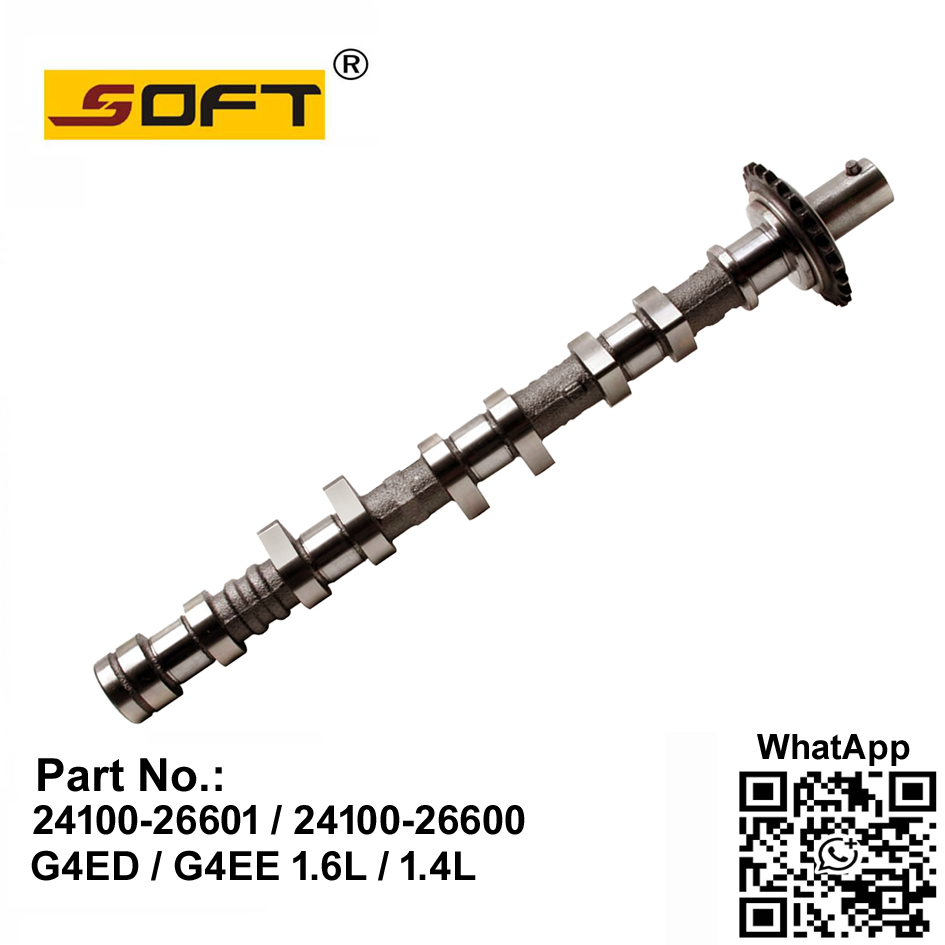
Specifically, when rebuilding a Korean engine, addressing these known vulnerabilities requires selecting a durable, high-quality Hyundai Kia camshaft. For instance, when servicing a G4ED or G4EE engine found in the 1999-2006 Hyundai Accent 1.6L and 1.4L models, utilizing exact OEM spec components like the 24100-26601 or 24100-26600 is non-negotiable. Restoring the exact factory specifications is vital for ensuring long-term reliability. Inferior aftermarket alternatives often utilize softer metallurgical compositions that simply cannot withstand the repetitive, hammer-like impact of the high-pressure fuel pump lifter.
Material Selection and Purchasing Guide
The purchasing decision for critical internal engine components should always be driven by objective metrics regarding manufacturing quality, material durability, and comprehensive warranty support. The valvetrain operates in a brutal environment, enduring extreme friction, high temperatures, and immense spring pressures thousands of times every single minute. Therefore, the metallurgical composition of your replacement part is absolutely paramount.
When evaluating a supplier, professional engine builders look for specific manufacturing standards. High-quality replacements are typically manufactured from either chilled cast iron or forged steel billet. Chilled cast iron is exceptionally durable and features microscopic graphite flakes that actually help retain lubricating oil directly on the lobe surface, making it ideal for standard commuter engines. In stark contrast, forged steel billet or induction-hardened steel is strictly required for modern roller-lifter applications and high-stress turbocharged environments.
For mechanics, DIY rebuilders, and fleet managers seeking reliable components without paying exorbitant dealership markups, partnering with a trusted manufacturer is essential. Choosing a premium replacement ensures proper drop-in fitment, restores lost volumetric efficiency, and provides the peace of mind that comes with stringent CNC-machined quality control. Sourcing parts from a dedicated supplier minimizes the risk of premature valvetrain failure.
Conclusion
Camshaft lift is the ultimate dictator of how your engine breathes, performing a delicate mechanical ballet thousands of times per minute. The precise distance a valve opens directly influences your vehicle's horsepower, low-end torque, fuel economy, and idle smoothness. Because this critical component operates under immense stress, regular, high-quality oil changes are your best defense against premature wear.
However, when the inevitable wear occurs, ignoring the symptoms will only lead to catastrophic engine damage. Replacing a worn valvetrain with precision-engineered parts is the only definitive way to restore your engine's power and efficiency. If you suspect internal wear, inspect your valvetrain immediately. We highly recommend visiting cndingjia.com to consult our reliable catalogs, find your exact fitment, and invest in a quality replacement to breathe new life into your vehicle.
Frequently Asked Questions
What happens if camshaft lift is too high?
If the lift exceeds the parameters of the original engine design, several catastrophic mechanical failures can occur. First, in interference engines, the valves may open too far and physically collide with the rising pistons, leading to bent valves and destroyed pistons. Second, excessive lift can cause coil bind, a condition where the valve springs compress entirely until the metal coils touch. When this happens, the valvetrain physically locks up. This can instantly snap the shaft in half, bend pushrods, or shatter rocker arms. Installing a high-lift performance profile always requires meticulous clearance checks and the installation of matching, high-performance valve springs.
Can a worn lobe cause a loss of power?
Yes, a worn lobe will cause a significant and highly noticeable loss of engine power. The lobes are responsible for pushing the valves open to a specific height. As the apex of the lobe wears flat due to friction or poor lubrication, the total lift is drastically reduced. Consequently, the valves do not open as wide as they should. This physical restriction severely limits the volume of air and fuel that can enter the combustion chamber and hinders the expulsion of exhaust gases. The engine essentially becomes choked, resulting in sluggish acceleration, poor throttle response, and reduced overall horsepower.
Are European and Korean valvetrain components interchangeable?
No, they are absolutely not interchangeable under any circumstances. These are highly proprietary components engineered specifically for a particular engine block's unique architecture. The physical dimensions, including overall length, journal diameter, lobe separation angle, and the specific placement of the lobes, are tailored to the firing order and cylinder spacing of that exact engine. Furthermore, the variable timing phaser attachments and high-pressure fuel pump drive mechanisms vary drastically between manufacturers. Attempting to install an incorrect part is physically impossible and would result in immediate engine destruction.
How much does it cost to replace these internal components?
The cost varies widely depending on the vehicle make, engine configuration like inline-4 versus V8, and local shop labor rates. While the physical part itself is often reasonably priced, the labor required is highly intensive. In modern architectures, replacement requires stripping down the top half of the engine. This includes removing the timing cover, timing chains or belts, valve covers, and often the high-pressure fuel system. This can easily require 6 to 12 hours of labor. Therefore, total repair bills typically range from $1,000 to over $3,000. Purchasing high-quality replacement parts direct from a reputable supplier can help mitigate the overall expense.
Do I need to replace lifters during a rebuild?
Yes, it is universally recommended by automotive engineers and professional machinists to replace the lifters or tappets whenever a new shaft is installed. During normal engine operation, the metal surfaces undergo a process called work hardening, where they wear into each other and create a microscopic, perfectly matched wear pattern. If you install old, uniquely worn lifters against a brand-new lobe, the mismatched, irregular surfaces will create localized high-friction points. This will rapidly degrade the new metal, often ruining your brand-new component within the first few hundred miles of driving.
How does variable valve lift improve fuel economy?
Variable systems improve fuel economy by dynamically adjusting the volume of air entering the engine based on real-time driving demands. During low-speed cruising or idling, the system engages a low-lift profile. This restricts the valve opening, which increases the velocity of the incoming air. High-velocity air mixes much more thoroughly with the injected fuel, creating a highly efficient, atomized combustible mixture. This efficient burn extracts more energy from less fuel. When acceleration is needed, the system switches to a high-lift profile to maximize air volume and power output.
Can I measure camshaft lift without removing the engine?
Yes, you can measure lift without pulling the entire engine block from the vehicle, though it does require removing the valve covers. Mechanics typically use a precise dial indicator mounted to the cylinder head with a magnetic base. The tip of the dial indicator is placed directly on the valve spring retainer or the pushrod. By manually rotating the engine crankshaft with a breaker bar, the mechanic can observe the dial indicator needle to measure the exact maximum downward travel of the valve. This measurement is then compared against factory service manual specifications to determine if excessive lobe wear has occurred.
Ningbo Dingjia Auto Parts Co., Ltd. is a professional enterprise specialized in manufacturing engine camshafts, connecting rods, crankshafts, and carbon fiber modification parts.